
Addison will consider leaving DART on Tuesday, Dec 2nd, 5:30PM meeting
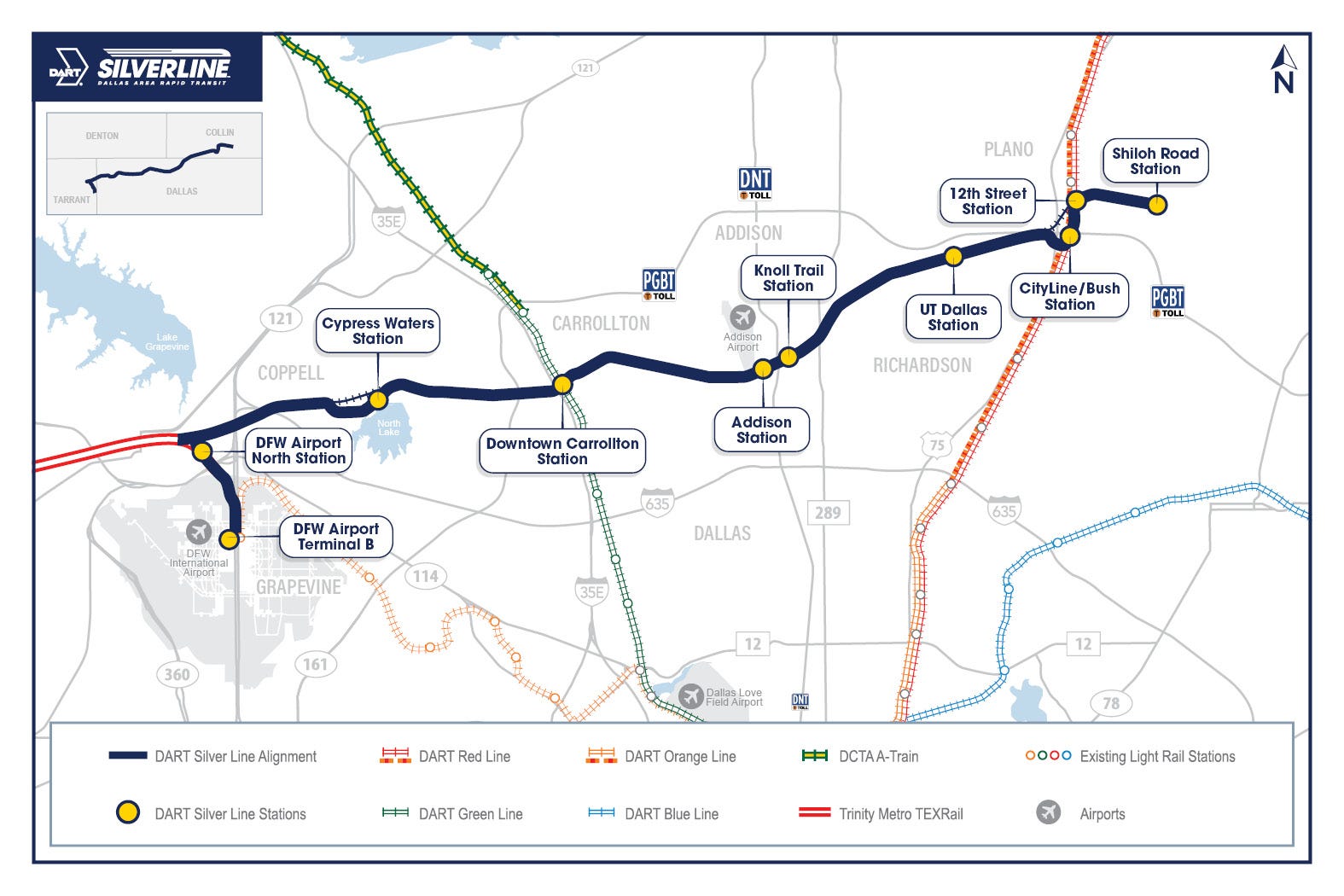
Despite just receiving the Silver Line, the council excludes it in their analysis, say they don't receive enough service


Email the council
The Addison City Council will hold a special meeting on Tuesday, Dec 2nd at 5:30PM that will decide if withdrawing from DART should be on the May 2026 ballot.
If you live or work in Addison use this link to email the council and update the form letter to tell them why regional transit is important to you. If you prefer to directly email them you can copy-paste the Mayor, Council, and City Manager emails below:
barfsten@addisontx.gov, dgardner@addisontx.gov, dliscio@addisontx.gov, hfreed@addisontx.gov, mwillesen@addisontx.gov, rsmith@addisontx.gov, cdefrancisco@addisontx.gov, dgaines@addisontx.govSpeak at the Tuesday 5:30PM meeting
If you live or work in Addison and are able to speak at the public meeting, fill out this public comment form. The public comments are before the council discussion, so make sure to arrive on time. Speakers are usually given 3 minutes to talk, but if there are many they might shorten it to 2.
The meeting is held at the new Addison Town Hall, located just north of Addison Circle Park. Addison Station / Transit Center is a 5-10m walk to the town hall.
Responding to Addison’s justifications
Addison followed the other cities’ template and created this web page justifying their decision. And here is their slideshow they plan on presenting at the Tuesday meeting. Let’s go through each point one-by-one:
“If (Plano, Highland Park, Farmers Branch, and Irving) elections are successful, the remaining costs and certain service reductions would be borne by the remaining cities.”
We don’t know how residents of those cities will vote. If this were a major concern, Addison could empower voters with more information from the May election and then put it on the November ballot
Any city that exits must pay off their portion of the debt. Future costs would be born by member cities but the cost of service would also be lower
“Route 305 – Express Bus, Addison Transit Center to Downtown Dallas (Will be discontinued January 2026)”
Addison chose to add GoLink and a circulator shuttle ($1.8M in yearly costs) instead of keeping this route
“According to the report, in FY23, the Town contributed $16.3 million, while only $9.5 million was spent in Addison.”
This report excludes the $2.1 Billion to construct the Silver Line and $30 Million in yearly operating costs.
Here’s a quote from the report on page 21:
Due to the recognition of capital expenses on a depreciation basis, any expenditures incurred on construction of the Silver Line — a significant element of DART’s capital plan — are not reflected in the FY 2023 allocations shown below.
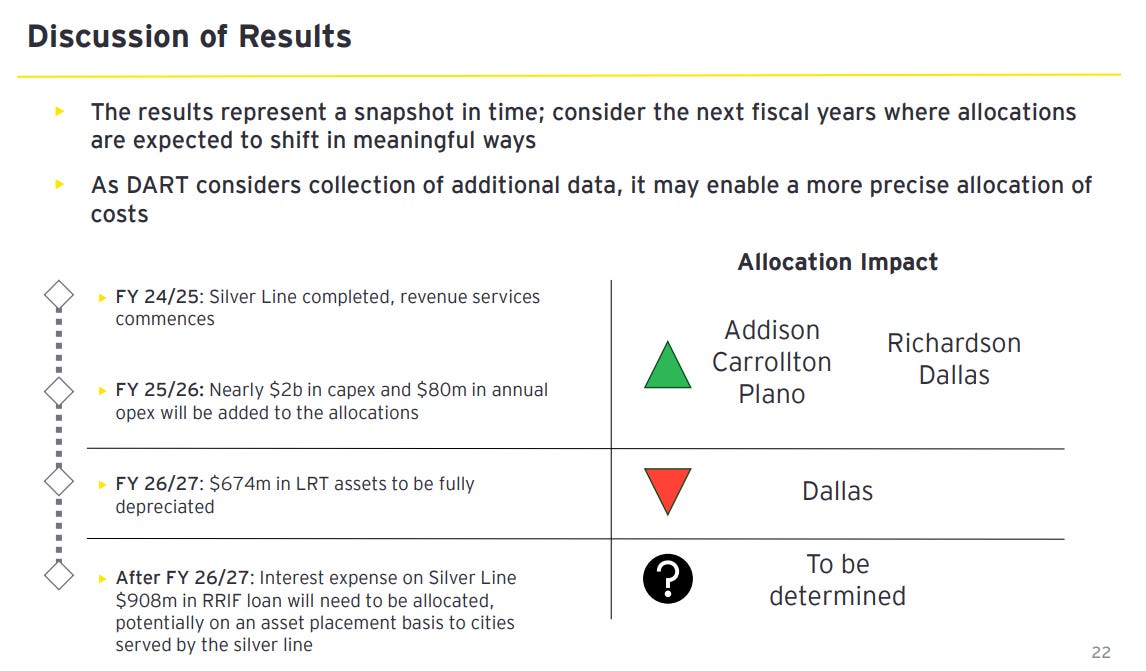
And here’s a link to the slideshow shown above that discusses the EY report.
Let’s do the simple math
The EY methodology is very simple, rail costs are allocated using even weights of stations and track miles. Anyone could have just added those in and seen what the results look like; we’ll do that now:
1 station
1.5 track miles
Addison’s portion: 0.5 * (1.5 / 26 miles) + 0.5 * (1 / 8 stations) = 9.13%
The 2 airport stations aren’t in a member city, so we use 8 instead of 10
$2.1 Billion construction * 9.13% / 20 year financial plan = $9.6M per year
$30M operating costs * 9.13% = $2.7M per year
And we can also add the $1.8M GoLink and Shuttle Addison requested
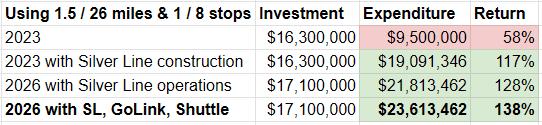
Ten years ago Addison demanded the Silver Line or else they would pull out from DART. So I think this methodology underweights its importance to Addison and overweights it to Dallas’s 2 stations and significantly more track miles. Regardless, even with this methodology, Addison completely flips from being a “donor city” to a donee. If a report completely flips its results from one year to the next with no actual changes, it’s less than useless, it’s dishonest.
Now that we’ve covered that, let’s get back to their assertions.
“Of $7.3M of Bus Service, the allocation factors used are likely not reflective of value to Addison”
“Bus Boardings based on location of boarding rather than destination”
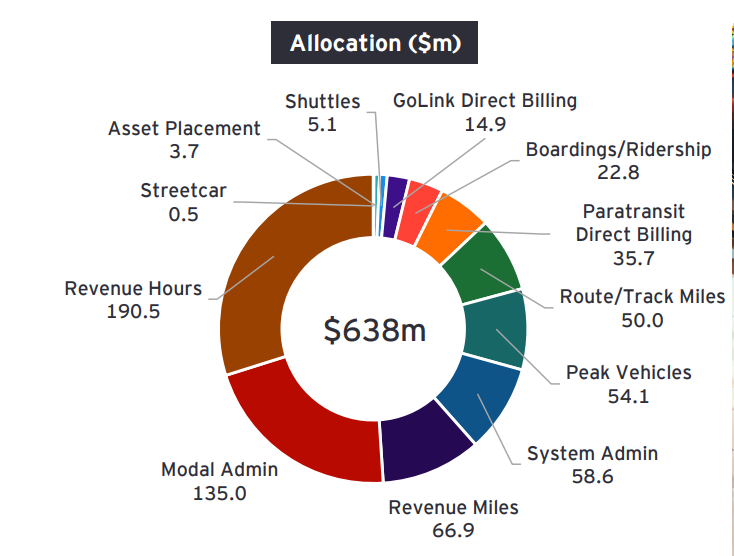
EY allocates $22.8M to boardings / ridership and 2.89% of that total to Addison. $22.8M * 2.89% = $658,920
Even if there were 0 boardings in Addison, it’s disengenous to worry about an over-allocation up to $650k, but not an under-allocation of $14M
By nature of being a hub, Addison Transit Center gives Addison:
Access to a dozen bus lines going in all directions to all member cities
The opportunity to get people waiting to transfer to spend money at nearby businesses
“From 1984 to 2025, Addison has contributed over $400.5 million to DART”
Constructing the Silver Line took more money than Addison’s lifetime contributions 5 times over
A train line can never be built alone in a city as small as Addison
“For Addison, uses other than transportation would provide some type property tax relief as they replace property tax funding for services currently funded by the General Fund.”
If Addison wants to pay for property tax reductions or economic development instead of regional transit then they should just be honest. There’s no reason to lie with statistics to justify the decision.
“Goals for DART”
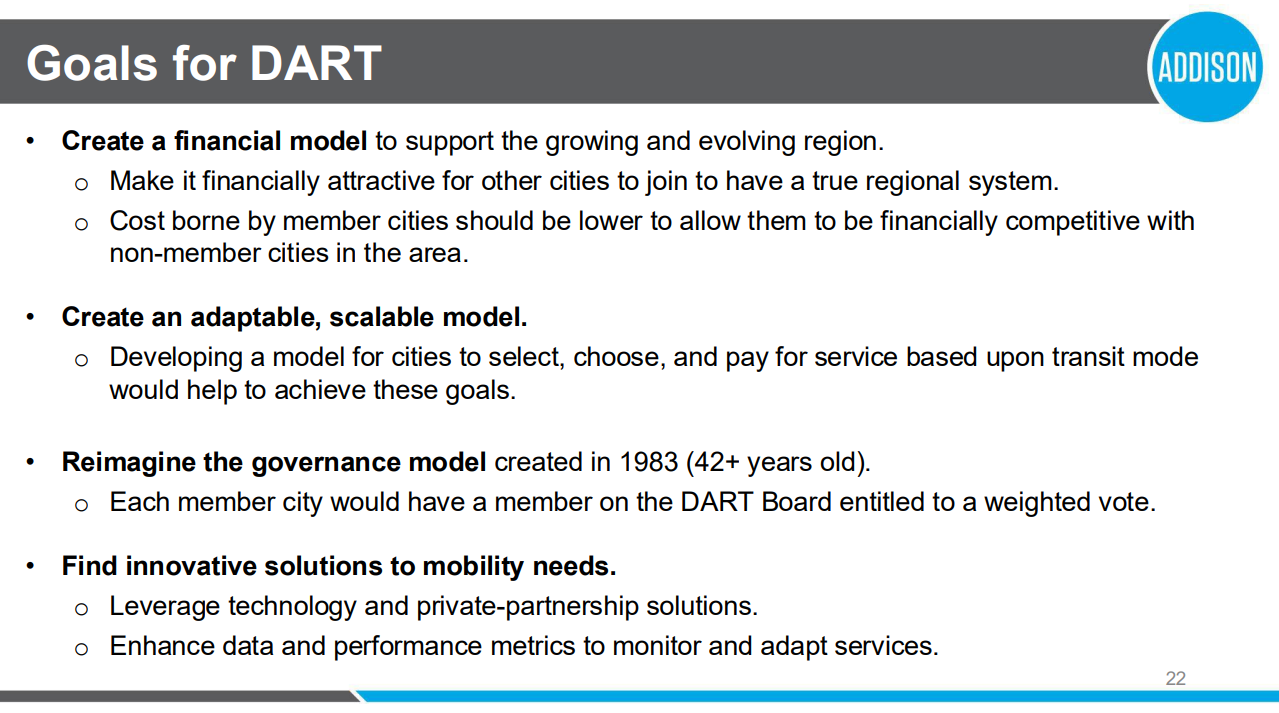
Trinity Metro (TM) in Fort Worth and Denton County Transit Authority (DCTA) both operate under a model with half the funding (and half the service), but no one has joined them since founding either
There’s no evidence that more cities would join at a lower cost, and even if they did, the lower funding would still result in lower service than now
City officials in Addison have said they want on-demand microtransit (GoLink) instead of buses. These modes can be useful in low-density communities, but otherwise are more expensive to operate, resulting in lower overall service.
Having city officials that don’t use transit make technical decisions likely won’t improve service
Addison currently shares a representative with Richardson and the Park Cities. If a population-weighted vote was introduced Addison would have 0.7% of the total vote. If they went with a sales tax weighted vote they would have 2% of the vote.
The current system gives Addison more of a say not less
Lastly, we need transit that works, not buzz words
Voters will potentially decide if money spent in their city will keep funding the transit system it built. But a public vote can only be fair if all voters have access to the same, accurate information. Currently they don’t.