
Equity In Motion
Black History Month, Brad Lomax, Disability, Public Transit, and The Lives That Depend on Access

Guest post written by Madison Noelle McNair — Madi is a 29-year-old Disabled & chronically ill Paratransit and public transit rider, and accessibility advocate in the DFW metroplex.
Transit Equity Day asks us to notice something most people only think about when it breaks: how we move through the world, and who gets left behind when systems are designed for the “average” body, the “typical” rider, or the “standard” commuter.
It’s not an accident that Transit Equity Day is marked on Rosa Parks’ birthday. Public transportation has always been a civil rights issue — About access, dignity, and the right to exist fully in public space. But that story doesn’t end with segregated seating. It extends into curb cuts and elevator outages, paratransit wait times and fare enforcement, and who is forced to plan their entire life around unreliable infrastructure.
This is where the story and legacy of Brad Lomax matters.
Brad Lomax was a Black Panther and a wheelchair user who lived with Multiple Sclerosis (MS). He understood, long before intersectionality entered the mainstream, that racial justice and Disability justice are inseparable. Living with a progressive, unpredictable disease shaped how he understood access: not as a convenience, but as a prerequisite for participation, organizing, and survival.
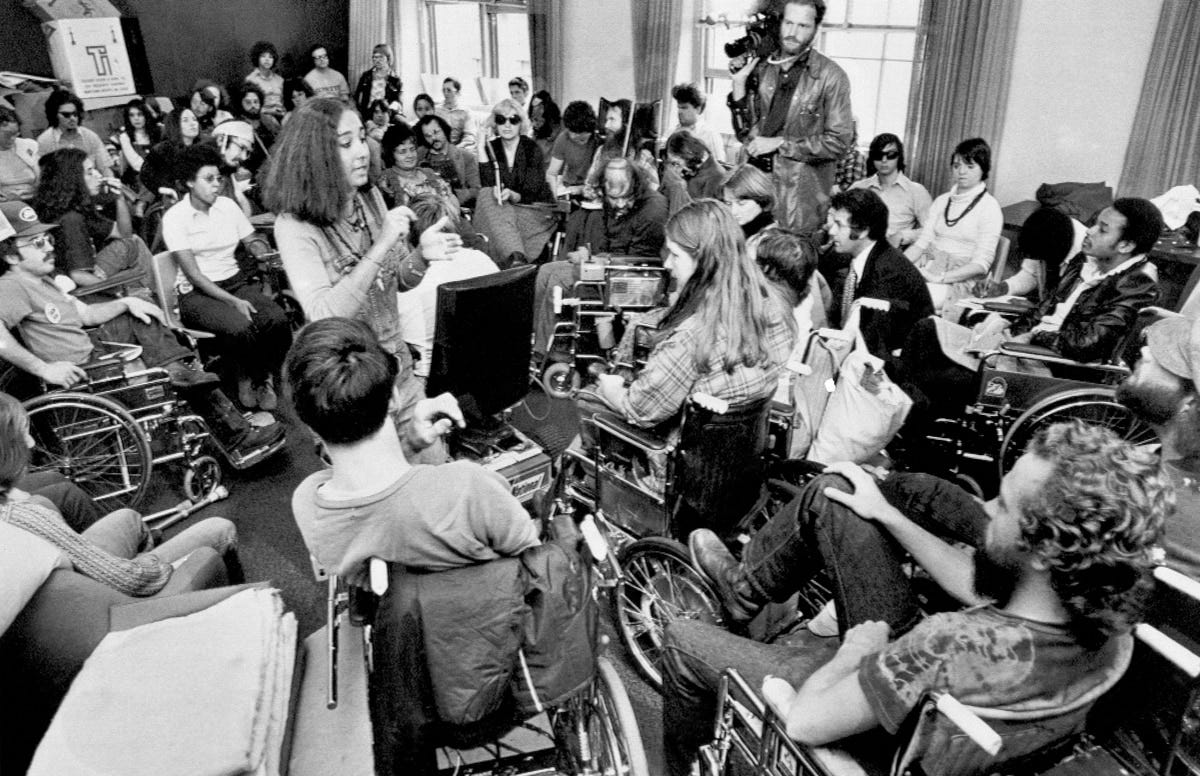
Brad Lomax – With the Black Panthers and alongside fellow Disability advocates like Judy Heumann – helped organize the 1977 Section 504 Sit-in that lasted 27 days at the San Francisco Federal Building; It is still the longest sit-in at a federal building in US history. It was a turning point that forced the federal government to finally enforce Section 504 of the Rehabilitation Act of 1973, that was vetoed TWICE by Nixon before finally passing and being enforced in 1977 – 4 years AFTER it was originally introduced as legislation. Section 504 states that no Disabled person can be excluded from or denied the benefits of any program or service that receives federal funding. Because most public transportation systems rely on federal dollars, this language fundamentally reshaped transit in the United States.
Once Section 504 was enacted, transit agencies could no longer legally operate systems that excluded Disabled riders. They were required to purchase accessible buses and rail cars, retrofit existing vehicles with lifts or ramps, build accessible stations with elevators and other features, and provide complementary paratransit for people who could not use a fixed-route service. Accessible public transit exists today because Section 504 made exclusion illegal, and because Disabled activists forced the government to act. And as of January 2026, Texas along with eight other states, have now sued the US government stating that Section 504 of the Rehabilitation Act is unlawful in its entirety and to stop the enforcement of it. It would be a huge step back to lose the protections and the rights that Section 504 promises to Disabled people in the US.
Brad passed in 1984 at 33 years old due to complications from his MS — Prior to the ADA being passed in 1990, but Brad Lomax was not alone in his pursuit of justice and equity. Black Disabled leaders like Vilissa Thompson, Stacey Milbern, Leroy Moore Jr., Fannie Lou Hamer, Harriet Tubman, and Haben Girma have long shown us that Disability justice is not separate from Black liberation — it is essential to it. Their lives and work remind us that access has always been a frontline civil rights issue, even when history fails to name it as such.
During Black History Month, the legacy of all Black Disabled individuals reminds us that Disability history is Black history, and that many of the accessibility features we now treat as baseline were won by Black Disabled organizers whose bodies and needs were routinely ignored and taken advantage of.
The history of Section 504 and the fight for equity isn’t abstract for me.
As a Disabled paratransit rider and accessibility advocate living with multiple rare diseases, I experience the promises and failures of transit equity every day.
In Dallas, DART is a vital resource for Disabled residents. Its buses, trains, and paratransit services make it possible for people like me to get to medical care, community spaces, and civic life. For many Disabled Dallas residents, DART isn’t optional; It’s the only way to move through the city. And yet, that access is becoming increasingly fragile.
In the last year, multiple cities — Plano, Irving, Addison, Highland Park, University Park, and Farmers Branch — within the DART service area have moved to withdraw from or dismantle the system altogether. These efforts often frame transit as expendable or inefficient, without grappling with who would be most harmed by its loss. When cities talk about removing DART, they are also talking about removing Disabled people from public life; Whether they say it or not.
Rare Disease Day is also approaching and it is not lost on me that 300 Million people worldwide live with one, 25-30M of those living with a rare disease are in the US. For many people with rare diseases like myself, transit isn’t just about getting from point A to point B. It’s about whether we make it to our specialist appointments, whether we make it to our tests and treatments, and whether independence is possible at all. When elevators are broken, stations lack seating, or paratransit is unreliable, the message is clear: this system was not built with you in mind.
I live with multiple rare diseases and that means constantly navigating systems that were not designed for bodies like mine; Medical systems, school systems, social systems, and transit systems alike. Rare diseases often involve fluctuating capacity, invisible symptoms, and needs that don’t fit neatly into checkboxes. On public transit, that can translate into routes that are technically “accessible” but functionally unusable, paratransit systems that exist on paper but fail in practice, and excessive wait times at fixed-route stops as well as for paratransit.
Accessible transit doesn’t only benefit mobility aid users like myself. It also supports people with chronic illnesses, elders, parents with strollers, people recovering from an injury, people whose disabilities are invisible until the moment they aren’t as well as cyclists and people using other alternative modes of transportation. Equity-focused transit design recognizes that bodies change, health is not static, and Disability is not rare; It should be recognized.
Brad Lomax understood this while living with MS and organizing for collective liberation. People with rare diseases, Disabled transit riders and accessibility advocates today understand it every time we calculate whether a trip is worth the cost.
What connects Transit Equity Day, Brad Lomax’s fight for racial and Disability justice while battling Multiple Sclerosis, Black History Month, Rare Disease Day, and my own experiences as a disabled transit rider and accessibility advocate is a simple but radical truth: Access is not charity. It is not a bonus feature. It is a measure of whose lives are valued enough to be planned for.
Finally, that means we cannot remove our public transit systems. Because removing DART would not only isolate the Disabled residents in those cities, but also neighboring cities that also have Disabled people who depend on our public transit system to get around our entire metroplex — and undo decades of progress at the same time.
Transit equity asks us to imagine cities where movement is not a privilege reserved for the healthy, the wealthy, or the lucky, but a shared public good. A city that lets you arrive at your destination just like everyone else.
It’s our turn to make our world more accessible, not less. Let’s not go backwards. Let’s not undo what these activists fought so hard to achieve so many years ago. Keep DART in the Dallas area. Keep our community connected. Keep the spirit of accessible public transit alive — with DART, right here, where it belongs.
Justice doesn’t just live in anniversaries or proclamations.
It lives in elevators that work, in paratransit that shows up, and in infrastructure that assumes you belong.
This isn’t about politics. It’s about people. It’s about community. It’s about equity. It’s about access. It’s about our lives.
Powerful piece connecting Lomax's legacy to today's transit fights. The point about cities withdrawing from DART being an act of removing disabled people from public life is something most peopel won't say out loud but it's exactly what happens. I remember when Section 504 protests came up in a college class and the professor framed it as just disability history, totally missing that it was Black Disabled organizers who led that fight.
HA HA - I missed the section in the Constitution that taxpayer funded mass transit is a constitutional civil right.
Pretty embarrassing that someone with an agenda of stopping cities from pulling out of DART would even create a transit equity day