
Here's how DART member cities plan on using $42M of former transit funding
List of GMP projects by city

Background
DART is funded through a voter-approved 1% sales tax rate, and that funding is restricted in how it can be used by state law. But those restrictions are broadly related to general mobility and allow for spending on infrastructure such as roads and parking garages.
Earlier this year DART approved sending 5% of each city’s sales tax contribution back to them rather than spending it on public transit. Named the General Mobility Program (GMP), DART made this deal in exchange for 2 things from the member cities:
Don’t hold a withdrawal election for the next 6 years
Work with DART to lobby the Texas legislature for funding and a new governance model
This meant cuts to transit service and maintenance projects, and further drastic cuts in the coming years if the Texas legislature is unwilling to provide funding. But it also meant that several cities called off their withdrawal elections, preventing the worst case scenario.
Project Criteria
Projects must meet both the state requirements and DART’s own requirements, which are as follows:
Increased DART services
Ex: increased frequency on a bus route
Alternative transit services
Ex: Paying for bus or on-demand service from a different provider
Construction and repair of arterial/collector streets and sidewalks along DART bus routes, in GoLink zones, or within 1/2 mile of a transit stop
Repair and construction of residential streets and sidewalks within 1/2 mile of a transit stop
Bike lanes within 3 miles of a transit stop
Project List
Dollar values have been truncated for readability
Addison
Ineligible due to holding a withdrawal election, would’ve been: $0.8M
Carrollton
Pavement panel repairs of larger roads along bus routes: $1.6M
Reconstruct signal at Keller Springs x Josey: $0.5M
Belt Line x Main Street crosswalk improvement design: $0.2M
Cockrell Hill
Saving funds for future projects: $0.03M
Dallas
Repaving Ross from 345 to Greenville: $8.0M
Repaving Mockingbird from 35 to Cedar Springs: $2.5M
Modify CBD Fair Park Link rail crossings for road, crosswalks, and bike lane: $2.5M
Reconstruct signals at Military x St. Augustine and along Lancaster: $2.5M
Pavement markings for roads, crosswalks, and bike lanes: $2.0M
Sidewalk and crosswalk improvements: $1.2M
Joppa pedestrian bridge: $0.7M
Engineering and design for Kiest and Marsalis bridges: $0.6M
Strategic mobility plan update: $0.5M
Dallas Streetcar operation and maintenance: $0.3M
Add curbs to Lake June bike lanes from Gillette to Pemberton Hill: $0.2M
Farmers Branch
Saving funds for future projects: $1.2M
Garland
Pave sidewalks on 5th near Downtown Garland Station: $1.3M
Glenn Heights
Reconstruct signal at Gateway x Bear Creek: $0.5M
Irving
Road and sidewalk repairs: $3.0M
Fixed-route van service through Via to replace former DART routes 225 and 255, which were cut partially due to the GMP, and fixed-route van service around Las Colinas: $2.1M
Plano
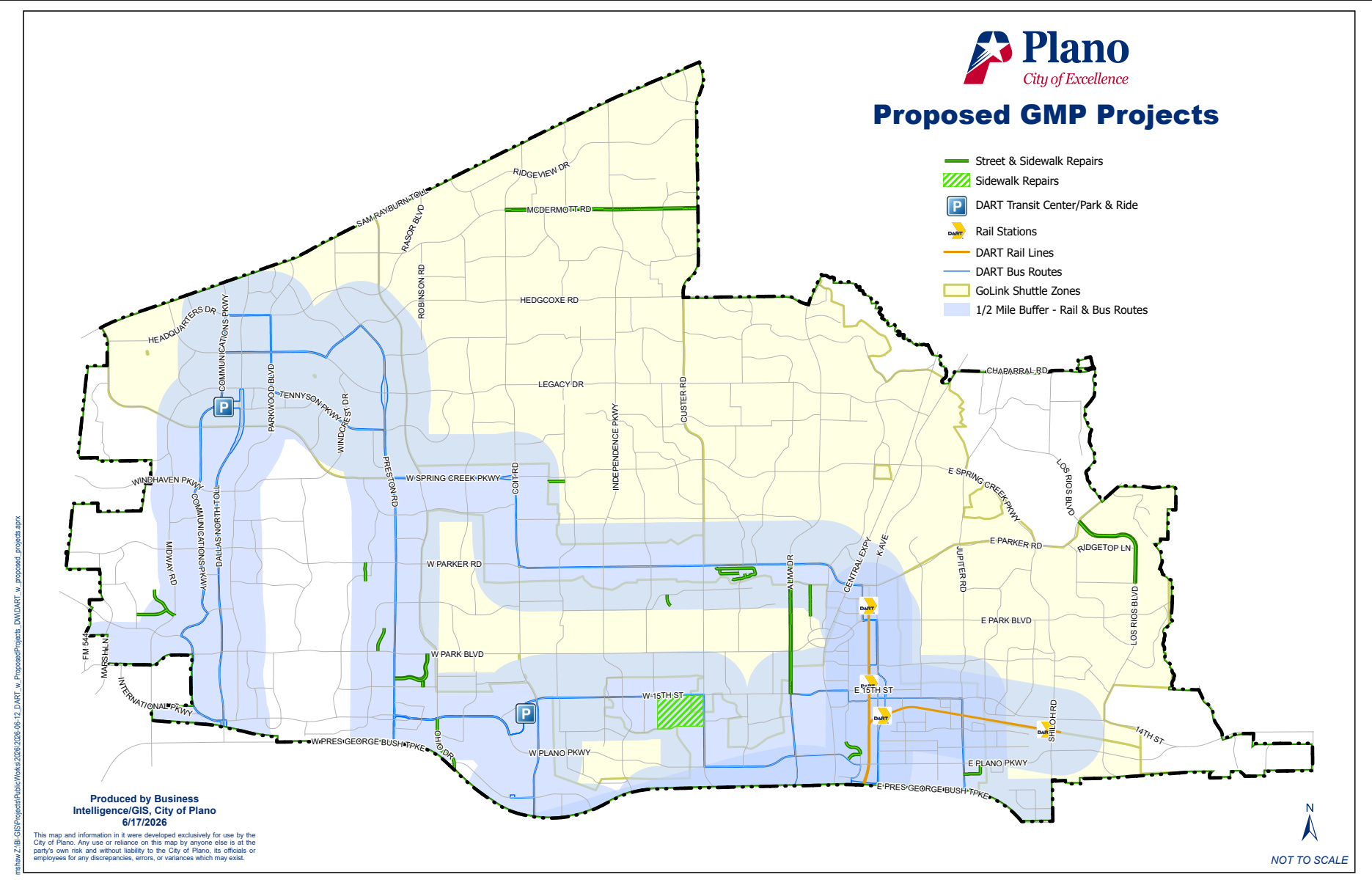
A large list of roadway repairs, with some sidewalk repairs and construction. Their allotment for this year is $5.8M. You can see their full list here:

Richardson
Coit paving from Roundrock to Campbell: $3.5M
Arapaho paving from Mimosa to Hampshire: $3.0M
Belt Line paving from Weatherred to 75: $2.1M
Abrams paving from Main to Grace: $1.0M
Plano Rd paving from Campbell to PGBT: $0.9M
Campbell paving from Glenville to Jupiter: $0.7M
Floyd paving plus bike lanes from Belt Line to Parkview: $0.7M
HAWK signal and upgraded bus stops across Renner near Tom Thumb: $0.2M
Traffic signal software subscription: $0.1M
Rowlett
Crosswalks, wayfinding, and parking around Downtown Rowlett station: $1.7M
University Park
Ineligible due to holding a withdrawal election, would’ve been: $0.3M
Our Thoughts
Due to the timeline, these projects were mostly road projects that the cities were already going to do, and instead just had DART fund them. This is understandable in isolation, but in practice this is taking 5% of voter-approved funding for transit, and using it on road infrastructure that doesn’t directly benefit transit riders. This has and will result in ridership declines.
There are several good projects on the list above, we are particularly grateful for these projects that used the funds to help future transit riders:
Garland: using all of their funds for sidewalks around Downtown Garland Station
Rowlett: for similarly using all of their funds to improve the pedestrian experience in Downtown Rowlett
Dallas: for the long planned Joppa pedestrian bridge
Richardson: for the new pedestrian crossing and upgraded bus stop
Carrollton: for the crosswalk improvements between Downtown Carrollton and the train and bus stops
Most other projects had sidewalks grouped with roads, making it difficult to tell how much was spent on active transportation versus routine road maintenance. For Irving’s van circulators through Via, the jury is out on whether the costs to replace those two routes, including city administrative costs, will be lower than reinstating the bus routes through DART.
In the future we would like to see at least 60% of the funding go to active transportation projects, with priorities based on resident input. This would allow cities the customization and budget flexibility they asked for, while still contributing to improving the experience of riders.
Some examples could be:
Coordinating with DART to restore lost routes that were cut due to the GMP itself
Improving frequency on popular routes
Widening or repairing sidewalks
Planting trees between the sidewalk and the road for shade and protection
Implementing Transit Signal Priority to improve bus reliability and speed
Upgraded bus stops or transit center amenities
Bike lanes that connect to stations
We would also like to see more public information from city officials displaying their current actions around lobbying the Texas legislature for funding and governance changes. The next 12 months will be incredibly important for the future of transit in North Texas, and we’ll be there every step of the way.